Withdrawing in Retirement: RRSP, TFSA or Non-Registered
In Quebec, the order you withdraw your money in decides how much tax you pay and how much OAS you keep. A guide to the RRSP, the TFSA and non-registered.
By Yeny Carias · Co-Founder

Pierre is 65 and has just retired. For thirty-five years he did one thing with his money: put it away. Now, for the first time, he has to do the opposite, and nobody has explained how.
His situation is the one thousands of Quebecers are in. Through your whole working life the rule was simple: save, and keep saving. However, the day you retire that rule reverses completely. It is no longer about building up, but about drawing down.
Before deciding how to empty your accounts, it is worth knowing whether you filled them in the right order. We explain that in TFSA, RRSP, or Non-Registered Account? The Strategic Order for Saving, the sister article to this one.
Think of your savings as the firewood you stacked for winter. You spent decades piling it up, log by log, without lighting anything. Retiring is not burning it all at once: it is deciding which pile you draw from, and how fast.
The piles are not equal. One is entirely yours. Another you have shared with the taxman since the day you stacked it. A third you have to start burning at a certain age, whether you need the heat or not.
Saving was stacking the firewood. Retiring is deciding what order to burn it in.
What almost nobody tells you is this: the order in which you burn those piles is a tax decision, not an administrative one. Getting it wrong can cost you thousands of dollars and reduce the government benefits you are entitled to.
The Traditional Withdrawal Order: Non-Registered, RRSP, TFSA
When people look for a simple rule, the same sequence almost always comes up: the non-registered account first, then the RRSP, and the TFSA last. It is a defensible rule, and it is a good starting point. It is also, often, an incomplete one.
1. Why Start With the Non-Registered Account
This is the woodpile that sits out in the weather: nothing here is sheltered. The capital you put into that account was already taxed at the time, and only the capital gains, the interest and the dividends are taxed now.
On top of that, capital gains get more favourable treatment than an RRSP withdrawal. In 2026 only 50% of the realized gain is added to your taxable income. Every dollar you take out of the RRSP, by contrast, is added in full, as ordinary income (Canada Revenue Agency, capital gains).
The point of starting here is to buy time: to let your registered accounts keep growing, sheltered, for as long as possible.
2. The RRSP: Why Withdraw Before 71
The RRSP is the biggest pile most Quebecers have, and also the most expensive one to burn. Part of that firewood was never entirely yours: the tax you did not pay when you contributed is still waiting. Every dollar you withdraw is added in full to that year's taxable income.
The classic trap is waiting. If you leave the RRSP untouched until 71, you concentrate large withdrawals into a few years and move up a tax bracket exactly when you have the least room. It is often wiser to make measured withdrawals earlier, between 60 and 65, when your income is low.
If your RRSP is large, there are more advanced tactics for softening that impact. We explain them in The "RRSP Meltdown" and the Hero's Return.
3. The TFSA: Why It Comes Last
The TFSA is the one woodpile that is entirely yours, and it is kept for last for one very concrete reason: its withdrawals do not count as income. They affect neither your tax credits nor your government benefits.
That makes it the ideal account for the expenses that do not fit an annual budget: a trip, a renovation, an unexpected medical cost. You can take $20,000 out of your TFSA without moving a single line on your return.
That is why it is worth treating it as the firewood you keep dry for the night it turns truly cold. When that night comes, and it usually does, you want it there.
The Two Rules You Do Not Choose: The RRIF at 71 and the OAS Clawback
Everything we have seen so far is yours to decide: which pile you draw from, how much, and in which year. The two rules that follow do not ask.
One lights a pile for you at a fixed age. The other charges you a toll when the fire climbs too high. You cannot avoid either one, but you can see them coming, and that is what a plan is for.
RRIF Minimum Withdrawal: The Pile You Start Burning at 71
By December 31 of the year you turn 71 at the latest, your RRSP has to become a RRIF. From that moment on, the law requires you to withdraw a minimum percentage every year, whether you want to or not.
That pile starts burning whether or not you are the one who lit it, and it is where a lot of people's plans break. It is worth understanding before it happens.
The percentage rises with age. Regulation 7308 of the Income Tax Act, in force in 2026, sets a factor of 5.28% at 71, 6.82% at 80 and 11.92% at 90. It applies to the balance on January 1 of each year.
An example makes the scale clear. If your RRIF balance on January 1 were $600,000, the mandatory minimum withdrawal would be $31,680 at 71. On that same balance, it would be $40,920 at 80 and $71,520 at 90.
That balance, of course, changes every year. But the mechanism matters more than the figure: the minimum is a percentage of the balance, and it grows with age.
From that follows a consequence that contradicts the popular advice. "Let it grow as long as you can" is not a free strategy: a larger balance produces a larger forced withdrawal, fully taxable, in the years when you have the least room to manoeuvre.
OAS Clawback: 15 Cents on Every Dollar Above the Threshold
OAS is the federal old age pension, and it is the benefit most quietly lost.
For every dollar of net income above the annual threshold, the government recovers 15 cents of your OAS. The threshold was $93,454 in 2025 and is $95,323 in 2026 (Government of Canada, OAS recovery tax).
Here is what that means in practice. In this example, with a net income of $110,000 in 2026, you are $14,677 above the threshold. The recovery would be $2,202 for the year.
What matters is not the figure, it is the timing. A single large RRIF withdrawal, made in the wrong year, lifts the flame just enough for that toll to be charged for twelve full months.
One frequent confusion is worth clearing up: this is not the same as the GIS, the supplement for low-income seniors. A household with significant savings does not receive it, because it runs out well below these income levels (Government of Canada, Guaranteed Income Supplement).
Why the Traditional Withdrawal Order Is Rarely Optimal
It fails for a specific reason: it treats retirement as a single decision, made once. In reality it is twenty-five annual decisions chained together.
There is no sequence that works for everyone, and that is not the interesting part. The interesting part is what replaces it.
Here is the finding that changes the conversation most: the question is not which tax bracket you want to stay in, but which are your cheap years and whether you are using them.
A rigid plan and an optimized plan can end up paying a similar average rate. What separates them is which years they fill. The rigid plan withdraws heavily exactly when the RRIF minimum is already pushing your income up, and wastes the cheap window before the public pensions start.
It is the difference between throwing half the woodpile on the fire in one night and keeping the house warm all winter.
Three coordinations follow from that, and they almost always matter more than the sequence:
- When you start QPP and OAS. Withdrawing heavily from the RRSP in certain years raises your taxable income and triggers the OAS reduction. We develop this in At What Age Should You Retire?.
- The mandatory RRIF minimums. They are not negotiable, so they are anticipated.
- Coordinating as a couple. Pension income splitting and the order between two holders change the overall result, as we see in Marital Status and Retirement.
There is a fourth, less comfortable one that a good plan should be able to model: the cheap tax room of the spouse who dies first disappears with them. Nobody knows who that will be, and that is exactly why the plan has to be able to represent that scenario instead of ignoring it. We write about that fragility in What Would Happen to Your Retirement in the Face of an Unexpected Goodbye?.
Coordinating all of that by hand, year after year, is precisely the work no spreadsheet does well. At AuraPlan we simulate those sequences to find the order that leaves more money available in your lifetime and a larger estate at the end. It is not a fixed formula: it is measuring the real impact of every withdrawal, year after year.
Pierre, 65: Two Ways to Withdraw the Same Money
Let us come back to Pierre, because the theory is easier to follow with a concrete woodpile.
This is his profile, in Quebec: $600,000 in the RRSP, $200,000 in the TFSA and $150,000 in a non-registered account. He lives alone, wants to spend $60,000 a year, and plans to 90. In this example we assumed a 6% return and 2% inflation.
In Scenario A he applies the traditional order: he exhausts the non-registered account, then the RRSP, and keeps the TFSA for last. In Scenario B, AuraPlan combines withdrawals from all three accounts from the first year, to keep income as flat as possible.
The starting savings are identical. The results are not:
- Available spending: goes from $5,800 to $5,900 a month.
- Final estate: goes from $416,935 to $449,518 in today's dollars, roughly $32,584 more for his heirs.
- Probability of success: rises from 77% to 79%. Two points seems small, but it is not the only thing that improves: in those same simulations, Pierre's median estate rises by about 8%. On how to read that probability, we write in Monte Carlo Simulations.
The difference between the two plans is not how much Pierre withdraws, but when. Scenario A creates a tax spike from 70 onward, by concentrating the RRSP into a few years. Scenario B keeps the fire even and avoids jumping a bracket.
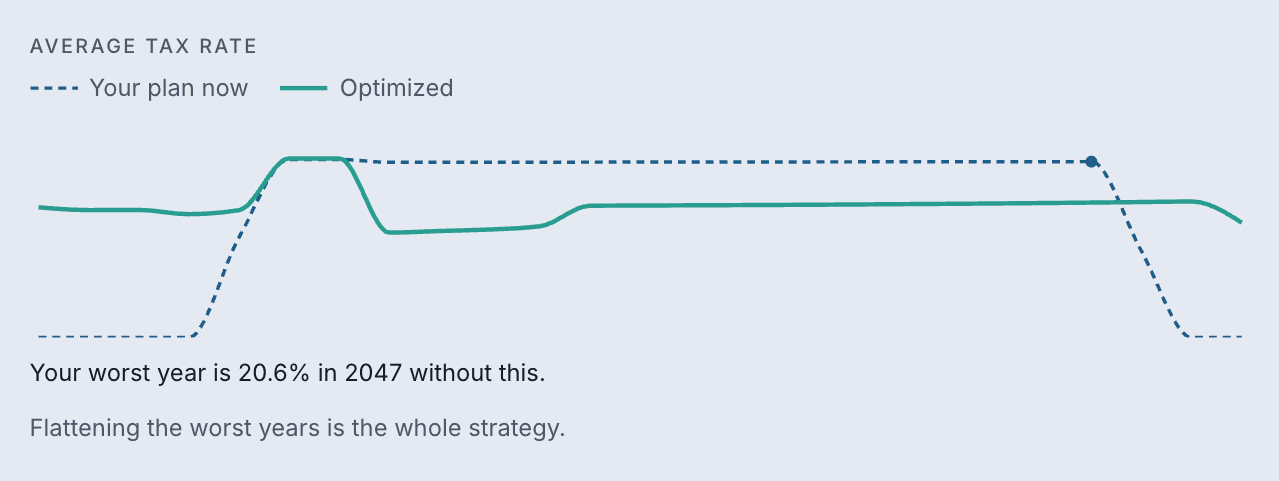
It is worth looking at any one year of that plan, because that is where the full mechanism shows. In 2042, with Pierre about to turn 81, his $60,000 of spending does not come out of a single woodpile. The mandatory RRIF minimum contributes $21,617 and the public pensions $19,311. The rest is $28,184 of additional withdrawals, split between the RRSP and the TFSA. That year's taxes come to $9,112. The figures are in today's dollars.
That split is the whole strategy. In the traditional plan, at 81, Pierre takes everything from his RRSP. In the optimized one he takes $17,695 from the RRSP and $10,489 from the TFSA: the same amount of money, but only part of it is added to his taxable income.
Put another way: close to seven of every ten dollars Pierre receives that year come from his own effort, and the rest from the public pensions. Knowing that in advance, year by year, is the difference between managing a plan and discovering it.
None of these numbers is a prediction. They are the result of one specific household, with specific assumptions, and they would change with yours. What does not change is the direction: sequencing withdrawals year by year pays more than applying a fixed order, and the saving concentrates in the years you know how to use.
Pierre did not have more money in Scenario B. He had the same firewood, and a plan for which pile to draw each log from.
That, in the end, is the only difference you can control: not how much firewood you stacked, but how calmly you decide to burn it.
That calm, in the end, is what you were saving for all along.
Want a plan that adapts to your life?
AuraPlan is in open beta — take the free assessment and see where your retirement plan stands.