Converting RRSP to RRIF: 71 Is a Deadline, Not a Plan
Converting RRSP to RRIF: there's a deadline, not an ideal date. What changes, partial conversion, and how it fits with your QPP and OAS.
By Jose Perdomo · Co-Founder
Francine turns 70 this autumn. Among the month's mail is a letter from her financial institution: her RRSP will have to be converted before December 31 of next year. Francine reads it twice and puts it in the drawer where she keeps things to deal with later. She has fourteen months, she thinks, and 71 strikes her as the age when the government wants her to make the switch.
But December 31 of the year you turn 71 is only the last day your RRSP can go on existing as an RRSP. What if the useful question isn't "RRSP or RRIF" but when, and how much?
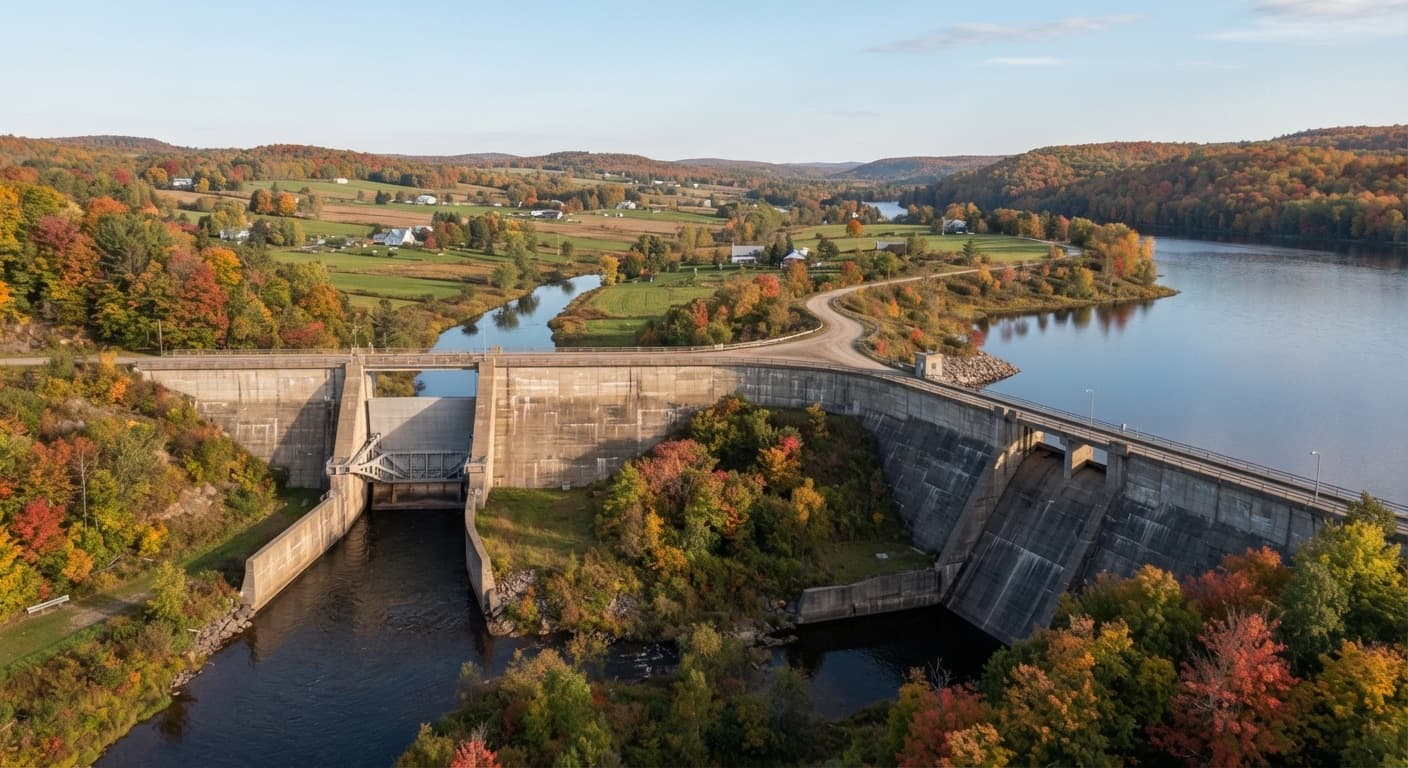
The people who run a dam don't wait for it to fill before opening the gates. They draw the level down little by little, well ahead of time, so the water that keeps arriving finds room and the river doesn't spill over into the valley. Your RRSP works the same way: it is water stored up over a whole working life, and sooner or later it will come down the river of your taxable income.
RRSP or RRIF: what really changes when you convert
Converting is not withdrawing. When you transfer your RRSP directly to a RRIF, there is no tax and no withholding at that point: the money changes containers and keeps growing sheltered from tax. You pay tax on each payment you receive from the RRIF, in the year you receive it, just as you would on an RRSP withdrawal.
The new container has rules of its own, though, and four matter here.
A mandatory minimum. Starting the year after you open it, you have to withdraw a minimum every year: a percentage of the balance on January 1, based on your age on that date. You can take out more, never less. Your RRSP doesn't require anything of you; your RRIF does.
Less withholding at source. Every RRSP withdrawal has tax withheld the moment you take it out. On the RRIF minimum, by contrast, nothing is withheld: neither federal tax nor Quebec tax. Withholding isn't your final tax: whatever isn't withheld, you pay in April. To avoid the surprise, you can set that amount aside or ask your institution to withhold part of each payment.
A tax credit from 65. RRIF payments count as pension income for the federal pension income credit, on up to $2,000 of income in 2026. RRSP withdrawals don't count. For a Quebec resident, that credit was worth at most $242 in 2025. The Research Chair in Taxation and Public Finance at the Université de Sherbrooke does that calculation. It also explains why the credit is worth a little less from 2026: its rate dropped from 14.5% to 14%. Quebec also has its own retirement income credit, with different rules, and it shrinks as family income rises.
Splitting with your spouse. From 65, you can allocate to your spouse up to half of your RRIF payments on your tax return. An RRSP withdrawal can never be split. What that is worth depends on the gap between your two incomes, and we look at it in pension income splitting and what it's really worth.
You don't have to wait until 71: partial conversion
Before 71, you can transfer part of your RRSP to a RRIF and leave the rest in the RRSP until the year you turn 71.
Think of it as opening a small gate before the dam fills. At 65, the minimum is only 4% of the RRIF balance, so a modest portion commits you to very little. In return, those payments already get the pension credit, can be split with your spouse and come out with no withholding on the minimum.
How much should you convert? To make use of the federal credit, the RRIF only needs to pay you $2,000 a year in 2026. For splitting with your spouse, though, the useful portion depends on how much you want to move from one income to the other. If you want to bring your RRSP's level down before 71, as in an RRSP meltdown, the RRIF is just the conduit. The real decision is how much you withdraw, and in which years.
There is one choice you only get to make once. If your spouse is younger than you, you can ask for the minimum to be calculated on their age instead of yours. A minimum based on a younger age is lower every year. But the choice is made when you fill out the RRIF application, and once made it can't be changed.
Age 71 is the last day to open the gate, not the best one.
The RRIF minimum only matters if it's more than you'd take out anyway
The minimum sounds scary because it's mandatory. But it only truly forces your hand in one case: when it is bigger than what you were going to withdraw anyway to live on.
Here is the minimum percentage for your age on January 1, according to the CRA's prescribed factors table, in force for 2026. Up to 70, the factor is 1 divided by 90 minus your age:
| Age on January 1 | Minimum (% of balance) | Per $100,000 |
|---|---|---|
| 65 | 4.00% | $4,000 |
| 70 | 5.00% | $5,000 |
| 71 | 5.28% | $5,280 |
| 75 | 5.82% | $5,820 |
| 80 | 6.82% | $6,820 |
| 85 | 8.51% | $8,510 |
| 90 | 11.92% | $11,920 |
The full table, year by year, is on our RRIF minimum withdrawal page.
Back to Francine. Suppose she converts her whole RRSP in the year she turns 71, and on the following January 1 the RRIF is worth $400,000. Since she is 71 on January 1 of that year, her minimum is 5.28%: $21,120. If she needs to draw $30,000 a year from her savings to live on, the minimum never forces anything on her. She was already taking out more.
Now imagine the same RRIF were worth $900,000. The minimum would be $47,520, well above the $30,000 Francine needs. That excess is taxable income she never asked for, and it lands on top of her QPP and her OAS. If her net income goes over the OAS clawback threshold, she starts paying back part of her pension.
That is the test worth running: compare the minimum with what you'd take out anyway. As long as the minimum stays below it, the RRIF forces nothing on you. Once it rises above, the water comes out whether you need it or not.
We ran that test with two of the example households from our simulations. We assumed a 4% return a year after retirement, 2% inflation, a life expectancy of 90, and QPP and OAS from 65. Denis holds almost all of the couple's savings in his name. In his first mandatory year, his RRIF minimum is $21,241, less than a third of the $72,643 they spend that year.
Yvon lives alone, with the largest RRSP among those households: $1.5 million a year before he retires. His first minimum, $75,952, comes close to his $82,016 of spending that year but stays below it, and that year his plan withdraws $17,910 on top of it. After that the gap widens, because his spending rises with inflation and his minimum falls with the balance. A large RRSP only forces your hand when it is also large compared with what you spend.
The minimum also grows with the balance. An RRSP you leave to grow untouched until 71 produces bigger minimums later, just when QPP and OAS are already flowing down the same river. "Leave it alone as long as possible" isn't free: with a large RRSP, it pushes income into the years when each dollar costs more.
Your conversion date, your QPP and your OAS
Your RRSP doesn't come down the river alone. From a certain age, two tributaries join it: QPP, which you can start between 60 and 72, and OAS, between 65 and 70. A tributary that arrives later arrives fuller: every year you wait increases the pension for life.
Until the tributaries arrive, the river runs low. Those are your cheap years: you no longer have a salary, you aren't collecting public pensions yet, and every dollar you take out of your RRSP costs little. If you defer QPP or OAS, you lengthen that stretch. If you wait until 71 to touch your RRSP, you let it go by empty, and the water comes down later, together with both tributaries.
This is where conversion comes in. Say you decide to fill those cheap years with RRSP withdrawals. If you convert part of it to a RRIF, that same money comes out from 65 with the pension credit, can be split with your spouse and has no withholding on the minimum. The conversion date doesn't change how much you take out: it changes the terms it comes out on.
At what age should you claim QPP and OAS? When we compared complete plans in our research, that decision had a flat optimum. Starting at 70 when 68 was best cost little. The shape of the withdrawals was the opposite: between a well-planned drawdown and a badly planned one, the difference was large.
A flat optimum means that, near the best age, starting a year earlier or later costs little. That best age changes from one household to the next, but it isn't worth losing sleep over choosing between 67 and 68. Far from that age, it does cost: claiming QPP at 60 out of inertia, without running the numbers, is no small detail. In at what age to retire in Quebec we explain how your pensions change with the age you choose.
In practice, it is a question of proportion. Make a reasonable call on your pension age and focus more on your RRSP's timetable: when to convert, how much to take out each year, and in what order relative to your other accounts. We work through that order in which accounts to draw on first in retirement.
You decide your QPP age once; the shape of your withdrawals, every year.
When to convert: what's up to you
There is no right age for everyone, because the answer depends on your own river. There are, though, four situations that help sort out the decision.
If you're 65 or older and already withdrawing from your RRSP. Converting at least part of it is usually a simple step. The payments qualify for the pension credit and can be split, in exchange for a small minimum.
If your spouse is younger than you. Decide before you open the RRIF whether you want the minimum calculated on their age. Once made, the choice doesn't change.
If your RRSP is large compared with what you spend. The minimum can end up exceeding your needs, and its percentage rises every year with your age. The years before your public pensions are the natural place to bring the level down, and the RRIF is one way to do it.
If your RRSP is modest. The minimum will probably never force anything on you, and converting at 71 won't cost you much. The decision that weighs most is still how much you take out each year.
At AuraPlan we do that calculation year by year for your household, with your accounts, your pensions and the RRIF minimum included, because each withdrawal changes the level in the years that follow.
Francine still has the letter in the drawer. Now she knows that December of next year is only the deadline. She can open the gate this very year and spread the water over more years, instead of waiting for the law to open it for her. That way, the water she saved all her life reaches her retirement years as irrigation, not as a flood.
Want a plan that adapts to your life?
AuraPlan is in open beta — take the free assessment and see where your retirement plan stands.